A modern business platform built around your point of sale

Every business has a Storey.

Every sale, every returning customer, every covered shift and every decision becomes part of the same picture — one register at the middle, with the rest turned on only when you want it.

Free software. Every module, no tiers, no per-feature fees.

Rivercrest Clothing Co.Register
  • Oxford ShirtWhite / M$68.00
  • Straight Leg JeanIndigo / 32$98.00
  • Leather BeltACC-BLT$62.00
Subtotal$228.00
Tax 8.845%$20.17
Total$248.17
Take payment

How it works

One core. Everything else clips on.

The core — selling, customers, stock, history, reporting — is always there. Everything past that is a separate piece you control, and all of it is free. Tap any of them.

One core. Every storey stacks on it.

Sale, customer, inventory, team, accounting — each one a real floor of your business, added when you need it. Turn one off and the building doesn't fall; it's just one storey shorter. The core is always there, and always free.

Insight
Accounting
Team
Inventory
Customer
Sale

Tap any piece. Off means it's gone from your screens entirely — not greyed out, not upselling you, just not there. And if one of them has a bad day, the register keeps taking money.

Most businesses have their Storey split across five systems that don't talk.

The register knows about sales. A spreadsheet knows about stock. Someone's phone knows the schedule. The bookkeeper finds out weeks later. Nothing is wrong with any one of those pieces — they just never add up to a picture of the business.

RegisterSpreadsheetNotebookPhoneStorey

While you're working

The Storey writes itself as the day goes.

These aren't features you switch on and configure. They're what already happens the moment the first thing happens.

  • A sale finishesStock dropsSale recordedBooks updated

    Ring up a jacket and the count for that exact size and colour comes down on every register at once, the sale lands in your history, and the money lands in your accounting. Nobody re-keys any of it.

  • A customer paysHistory updatedPoints added

    The purchase attaches to their record as it happens, so the next time they walk in, what they bought last time is already on the screen.

  • Points cross a tierReward unlockedShown at checkout

    When someone's spending crosses a threshold you set, the reward is live on their next sale — your staff don't have to remember who earned what.

  • Someone clocks outHours recordedPayout ready

    Time goes to the timesheet, tips and commission land on the same shift, and payday is arithmetic that's already been done.

  • An invoice comes dueMarked overdueReminder queued

    Unpaid work chases itself instead of sitting in someone's head until they remember it.

What you get out of it

Start from what you wanted, not from a feature list.

Sell fast, without a line building

A counter that takes a payment in a few taps, whether that's a coffee, a fitting-room armful, or a table of eight splitting the check.

  • Register
  • Tables
  • Kitchen tickets
  • Tips
  • Split checks

Know who's standing in front of you

Every purchase files itself onto the customer's record, so their history and what they've earned are on screen before you ask.

  • Customers
  • Loyalty
  • Notes

Keep the team and the shelves straight

Who's on, who's clocked in, what's running low and what needs reordering — all part of the same Storey rather than four spreadsheets.

  • Stock
  • Scheduling
  • Time clock
  • Payroll
  • Recipes

See how the day went without digging

Sales, takings, tax and what you're owed are already added up, because they were recorded as the day happened, not typed in after it.

  • Accounting
  • Sales history
  • Invoicing
  • Till counts
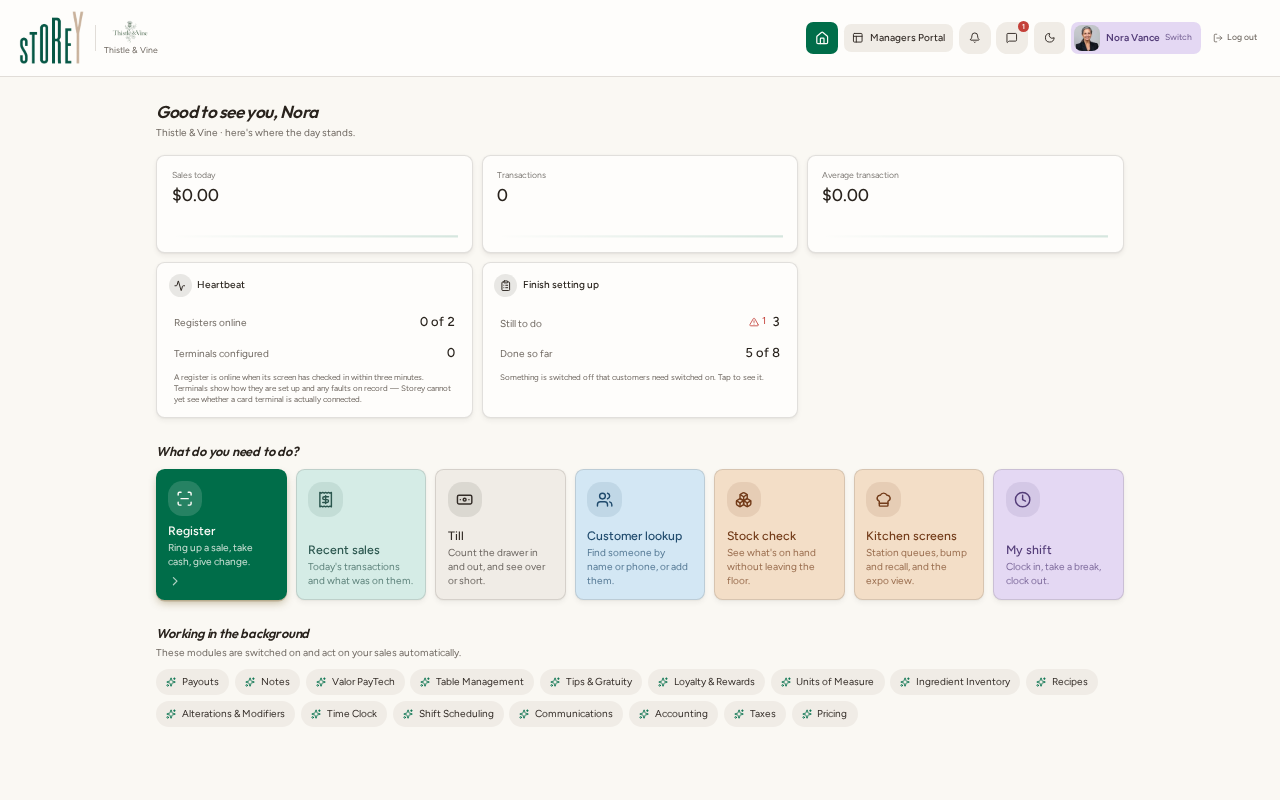
Storey Floor Home for Thistle & Vine, showing seven colorful workspace tiles and active business modules

Your day, connected

Go from five systems that don't talk — to one that does.

You stop carrying the gaps between tools in your head. Sales update stock, customer history fills itself in, and the numbers are ready when you need them — so your day is spent running the business, not reconciling it.

Try it yourself

Walk into a business mid-Storey.

No sign-up, no card, no sales call. Pick the kind of business you run and you'll land in a working store with real sample data — walk the floor, take a payment, then go through the back office.

Select your kind of business

Retail

A standard retail counter: ring up products, track stock, sell across the counter.

  • Boutique shops
  • General retail
  • Specialty stores

Full-Service Restaurant

Full seating, table service, and a real kitchen behind it.

  • Sit-down restaurants
  • Bistros
  • Fine dining

Quick Service Restaurant

Pay at the counter, tip on the spot, and a ticket system built for a counter, not a table.

  • Coffee shops
  • Food trucks
  • Delis
  • Taco trucks

Invoicing

Bill for work or goods instead of ringing up a register — built for anyone whose business runs on invoices, not checkout lines.

  • Contractors
  • Wholesalers
  • Specialty retailers
  • Designers
  • Custom goods and artwork

Reservations

Book a place for a night or a week: a map of what you rent, a timeline of who has it when, and holds you can move without a fight.

  • RV parks & campgrounds
  • Hotels
  • Vacation rentals

Booking

Book a room, a person, or both at once: treatment rooms and saunas on a map, your team on a timeline, and appointments you can move without double-booking anyone.

  • Salons & spas
  • Wellness studios
  • Appointment-based services

What's different

Most POS makes you fit the software. This one fits you.

A fixed feature set means every business gets the same screens and works around the parts that don't apply. Storey starts from what your business actually does.

A bakery that also invoices

Morning counter sales run on the register. Wedding-cake orders go out as invoices with a deposit and a balance due. Same catalog, same customers, same books — one system, two modules on.

A restaurant with a retail shelf

Table service and a kitchen display for the dining room, plus straight counter sales for the bottles and jars by the door. Nothing gets forced into the wrong screen.

Turn things on. Turn things off.

Every part of Storey — tables, kitchen tickets, invoices, loyalty, payroll — is a separate piece you switch on when you want it. Switch it off and it disappears from your screens completely.

Nothing you don't need on your screen

A coffee counter never sees table maps. A contractor never sees a kitchen display. Your staff only look at the buttons your business actually uses.

One bad module doesn't break your register

The pieces run apart from each other. If something goes wrong in one of them, the till keeps taking money and the rest of the day carries on.

One system, not one product per industry

Most companies sell a restaurant build and a separate retail build. Storey is a single system, so a business that is a bit of both doesn't have to pick a side.

Why Storey exists

Point of sale has a trust problem. We built the opposite.

Processing fees that are hard to compare. Contracts that tie a business to hardware and a processor it didn't pick. Features held back behind upsells. Storey was built the other way around.

The software is free. All of it.

Every module, every feature, no tiers and no per-feature charges — ever. There is no plan to outgrow and no upgrade to buy. You turn a module on because you need it, not because you paid for it.

We make our money on processing, not on you

Card processing is the one paid part, and it's your choice: process through us, or keep the processor you already have. Either way you keep the entire software, in full, with nothing switched off.

Match-or-beat pricing, with a rate guarantee

If you do process with us, bring your current statement and we'll match or beat the rate, then guarantee it. The processing has to win on its own numbers — free software isn't a way to hide a worse rate.

New things get built quickly

Building software has gotten genuinely faster and cheaper, and Storey ships on that pace. If you need something that doesn't exist yet, that's a real request we can build — not a multi-year line on a roadmap.

Answerable to the businesses running on it

This was built by people who got tired of how this industry treats the businesses it sells to. No proprietary lock, no hardware you can't replace, no feature held back as an upsell.

Read the longer version →

FAQ

Questions, answered in the first sentence

What is Storey?

Storey is a point-of-sale system for small and mid-sized businesses. It's one core system — register, customers, stock, sales history and reporting — with independent modules layered on top for things like table service, kitchen tickets, invoicing, loyalty, tips, scheduling and payroll.

You switch modules on when you want them and off when you don't, and the screens your staff see change with them.

How is Storey different from other POS systems?

Most point-of-sale companies ship one fixed feature set per industry and make your business work around it. Storey is a single system where you choose which parts run, so a business that doesn't fit one label doesn't have to pretend it does.

The modules also run independently of each other, so a problem in one part of the system doesn't take the register down with it.

Is Storey free to try?

It's free to try and free to run. There's a full working demo you can open in your browser with no sign-up, no card and no sales call — a real store with real sample data, not a video. And the system itself is free to use: every module, no tiers, no per-feature charges.

The only paid part is card processing, and only if you choose to process through us. Keep your current processor and the software stays exactly as complete as it was.

Why is Storey free?

Two reasons, plainly. First, we're tired of what the rest of the point-of-sale industry does to merchants — nickel-and-diming for every feature, charging per module, locking a business into whatever software plan it can afford instead of what it actually needs to run. Second, we started as a payment processor, not a software company. Giving away the full platform costs us nothing to offer and everything to prove: the software is how we introduce ourselves to your business, not how we profit from it.

If you process payments through us, that's where we make our money. If you'd rather keep your current processor, you're free to do that and keep using the entire software anyway — no module fees, no downgrade, no catch. Think of it like a wireless carrier giving away the phone because it makes its money on the plan. We give away the software because our business has always been payment processing — we just built the point-of-sale system a processor should have offered all along. And we back that processing with a match-or-beat pricing policy and a rate guarantee, so this isn't a bait-and-switch into worse rates; the processing is priced to compete on its own.
All questions →

For teams building their own POS

Did you build a point of sale and never got around to payments?

Valet by Storey

Valet plugs a real, working card-payment integration into software you already built — a hosted widget or a plain API — without your team touching a card number or becoming a payments company.

See how Valet works

Your Storey keeps going. So does this.

Look around the demo first — it's the whole product with sample data in it. When something you need doesn't exist yet, that's a request we can build, not a wait.